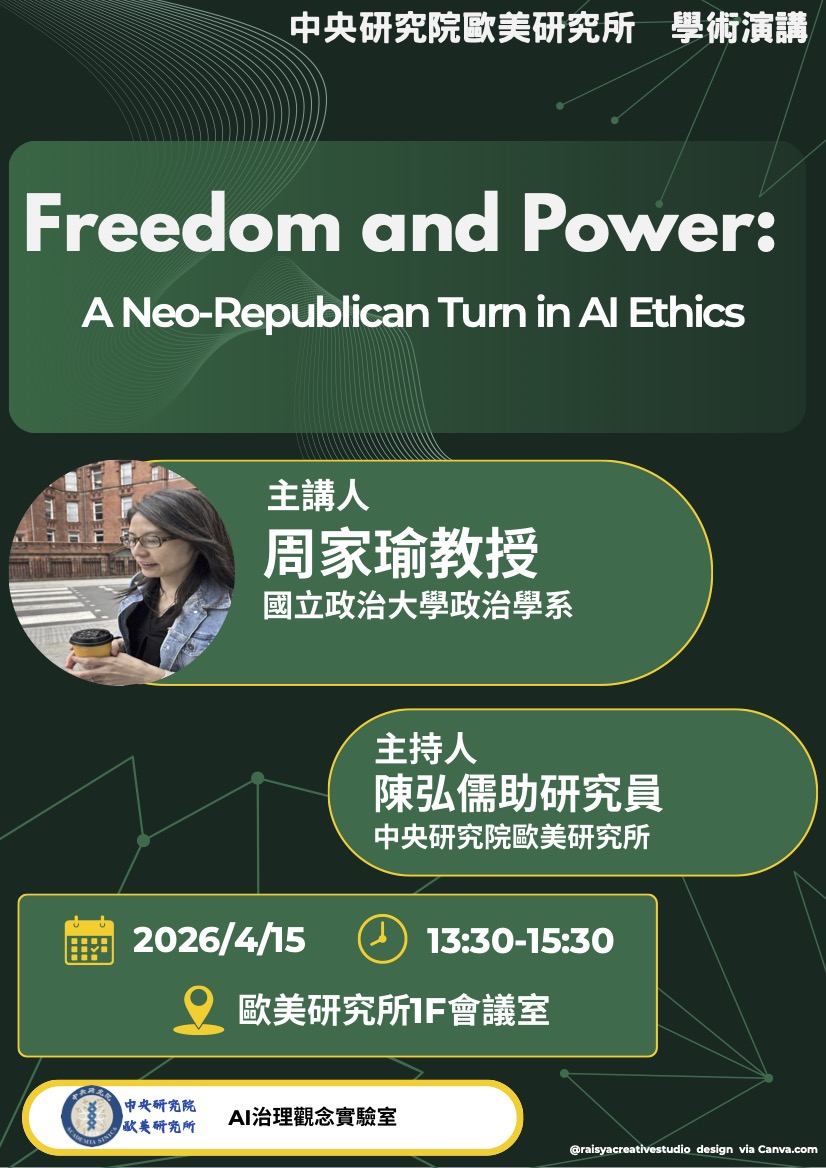
Freedom and Power: A Neo-Republican Turn in AI Ethics
本所「AI治理觀念實驗室」邀請國立政治大學政治學系周家瑜教授於2026年4月15日(星期三)下午1時30分,於本所研究大樓一樓會議室舉行演講,講題為 "Freedom and Power: A Neo-Republican Turn in AI Ethics",由本所陳弘儒助研究員主持,歡迎踴躍參加。
主講人:周家瑜教授(國立政治大學政治學系)
主持人:陳弘儒(中央研究院歐美所助研究員)
Abstract: This article explores the ethical and political implications of artificial intelligence (AI) through the lens of intellectual history. Starting with a neo-republican turn in AI ethics, it poses the fundamental question: Can individuals retain freedom under such powerful technological structures? The answer, I contends, depends upon the conception of freedom adopted. Contemporary AI ethics and regulation often presuppose a liberal understanding of liberty as negative liberty (mere non-interference) which prioritises harm prevention and technical solutions to issues such as bias and discrimination. Nonetheless, this framework, rooted in Thomas Hobbes's political thought, proves inadequate for addressing the subtler forms of domination exerted by algorithmic power, including micro-domination through data collection, personalised nudges, and uncontrolled corporate influence over decision-making processes.
By contrast, the republican tradition, as reconstructed by scholars such as Quentin Skinner and Philip Pettit, conceives liberty as non-domination; that is, freedom should be defined not merely from actual interference but from subjection to arbitrary power. Tracing the genealogy of these rival conceptions to the seventeenth-century debates between Hobbes and English republicans, the article indicates how Hobbes deliberately redefined liberty as absence of external impediments to render it compatible with absolute sovereignty, thereby depoliticising the concept. In sum, contextualising neo-republicanism historically reveals its superior analytical and normative resources for AI ethics. Ultimately, the article advocates shifting the focus from questions of fairness or goodness to how AI redistributes power, urging institutional designs that mitigate domination and foster genuine independence.