2026
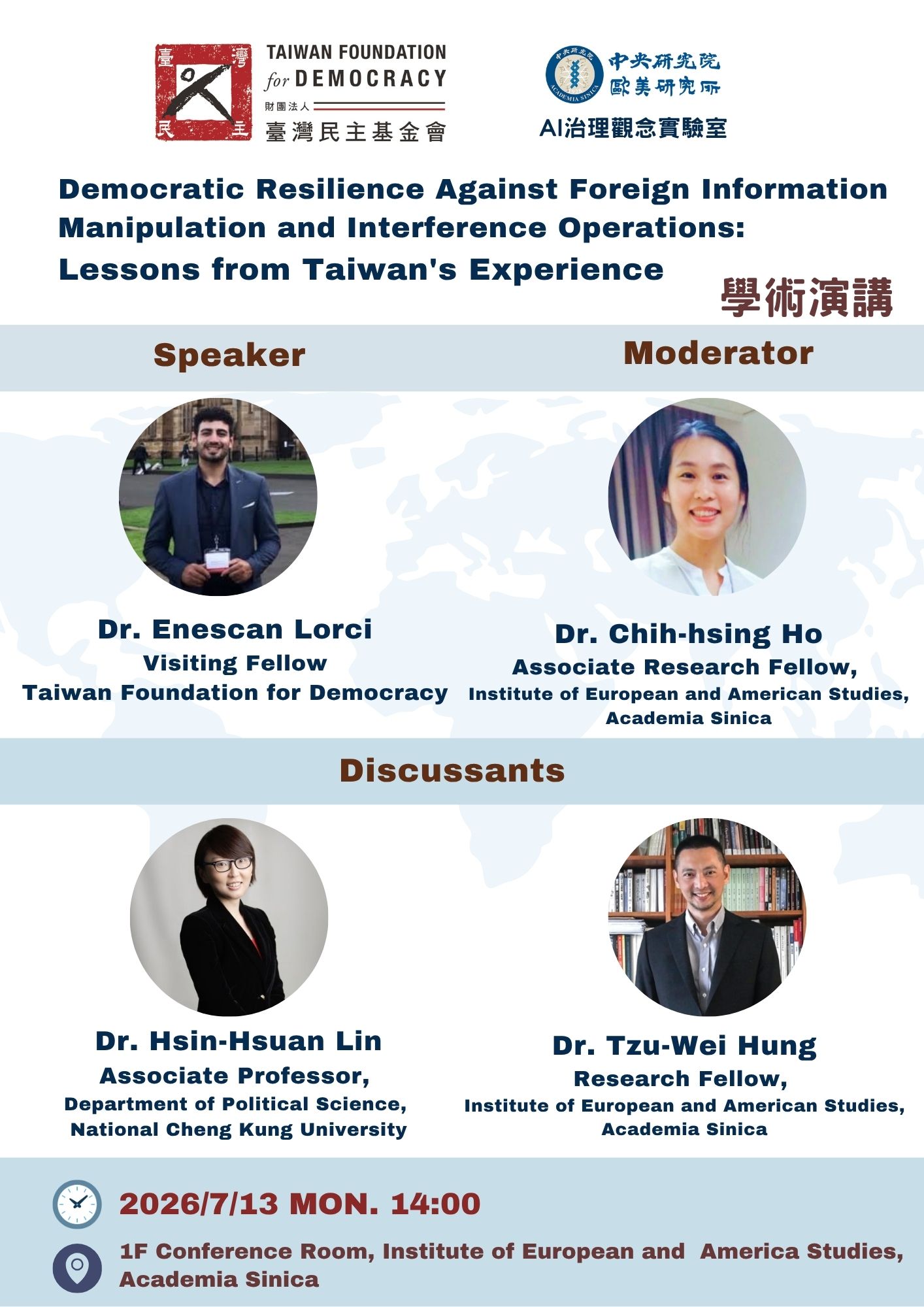
Democratic Resilience Against Foreign Information Manipulation and Interference Operations: Lessons from Taiwan's Experience
本所「AI治理」觀念實驗室與臺灣民主基金會共同主辦,邀請 Enescan Lorci, PhD 羅埃尼博士(臺灣民主基金會訪問學人)於民國115年7月13日(星期一)下午2時於本所研究大樓一樓會議室舉行演講,講題為「Democratic Resilience Against Foreign Information Manipulation and Interference Operations: Lessons from Taiwan's Experience」,由本所洪子偉研究員與國立成功大學林昕璇副教授擔任與談人,何之行副研究員擔任主持人。 主講人:Enescan Lorci, PhD 羅埃尼博士(臺灣民主基金會訪問學人) 與談人:洪子偉研究員(中央研究院歐美所)、林昕璇副教授(國立成功大學) 主持人:何之行副研究員(中央研究院歐美所)
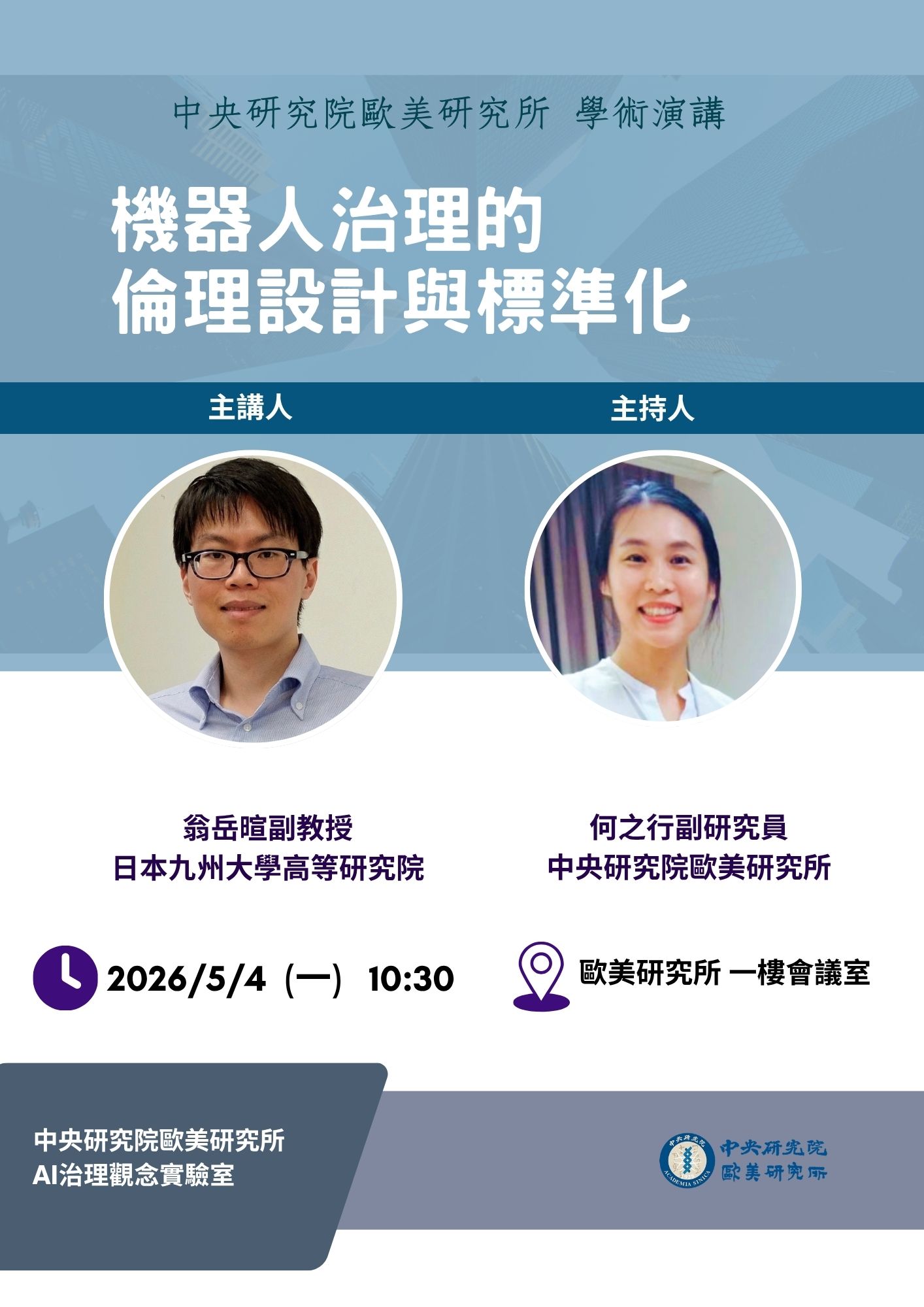
機器人治理的倫理設計與標準化
本所「AI治理觀念實驗室」訂於民國115年5月4日(星期一)上午10時30分於本所研究大樓一樓會議室舉辦專題演講,邀請翁岳暄副教授(日本九州大學高等研究院・稻盛前沿學者)蒞臨主講,講題為:「機器人治理的倫理設計與標準化」,由本所何之行副研究員主持,歡迎踴躍參加。 主講人:翁岳暄副教授(日本九州大學高等研究院・稻盛前沿學者) 主持人:何之行副研究員(中央研究院歐美所) 摘要: 本演講將探討人工智慧倫理標準在智能機器人治理中的應用。具體而言,著重分析目前廣受各界關注的「AI步調難題 (The AI Pacing Problem)」以及應用人工智慧倫理標準的可能性。除了探討機器人技術在日本社會的應用現況, 本演講還主張建立一個依賴非約束性且靈活的人機互動監管框架,以確保利害關係人能夠管理日常人機互動中固有的倫理、法律和社會影響(ELSI)風險。透過將人工智慧倫理標準納入人形機器人和社交機器人的開發流程,機器人開發者能夠在不與現有機器人監管「硬性法律」相衝突的情況下,透過軟法為基礎的治理融入負責任的創新和研究原則。本演講將透過兩個案例研究探討倫理機器人設計方法,分析了其潛力和局限性。
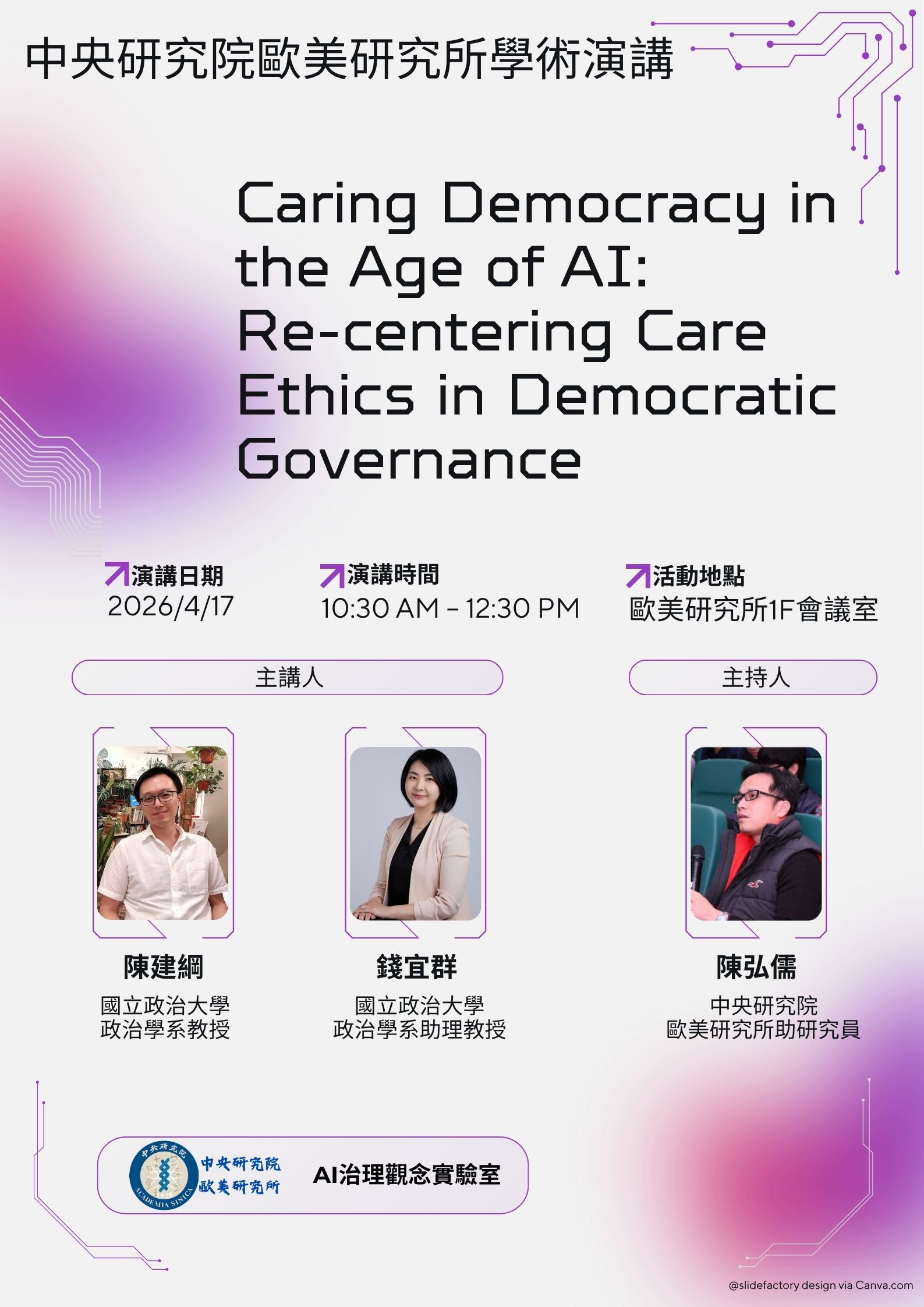
Caring Democracy in the Age of AI: Re-centering Care Ethics in Democratic Governance
本所「AI治理觀念實驗室」邀請國立政治大學政治學系陳建綱教授與錢宜群助理教授於2026年4月17日(星期五)上午10時30分,於本所研究大樓一樓會議室舉行演講,講題為「Caring Democracy in the Age of AI: Re-centering Care Ethics in Democratic Governance」,由本所陳弘儒助研究員主持,歡迎踴躍參加。 主講人:陳建綱教授(國立政治大學政治學系) 錢宜群助理教授(國立政治大學政治學系) 主持人:陳弘儒(中央研究院歐美所助研究員) Abstract: This paper reinterprets democratic governance through the lens of care ethics, exploring whether artificial intelligence can fix—or instead worsen—the ongoing "care deficit" that liberal democracies have long experienced. Drawing on the care ethics literature, we contend that liberal-procedural models of democracy render dependency, interdependence, and vulnerability over time politically invisible, while shifting care responsibilities into gendered and racialized labor markets. They also valorize participatory citizenship that caregivers often lack time for and normalize market-based substitutes for public care. By integrating care ethics with procedural democratic theory, we show how procedural elements, often seen as ideal, tend to prioritize rational autonomy and discursive equality while neglecting the embodied, emotional, and temporal aspects of political life. We contend that a democracy attentive to care must expand its normative focus beyond procedural inclusion to emphasize relational responsiveness. To address these gaps, we propose four care-centered democratic capacities—attentiveness, responsibility, competence, and responsiveness—along with answerability, as criteria for assessing institutions, technologies, and accountability measures. We also develop a care-ethical framework for design and oversight that involves co-design with caregivers, public-interest data infrastructures, algorithmic impact assessments aligned with due process, and time-based social rights such as care income or care credits. The paper concludes with a reform agenda for care-oriented AI and democratic renewal, stressing that only by re-centering care can democracies resist the dehumanizing effects of technological automation competition. Keywords: care ethics; procedural democracy; AI governance; democratic repair; social reproduction
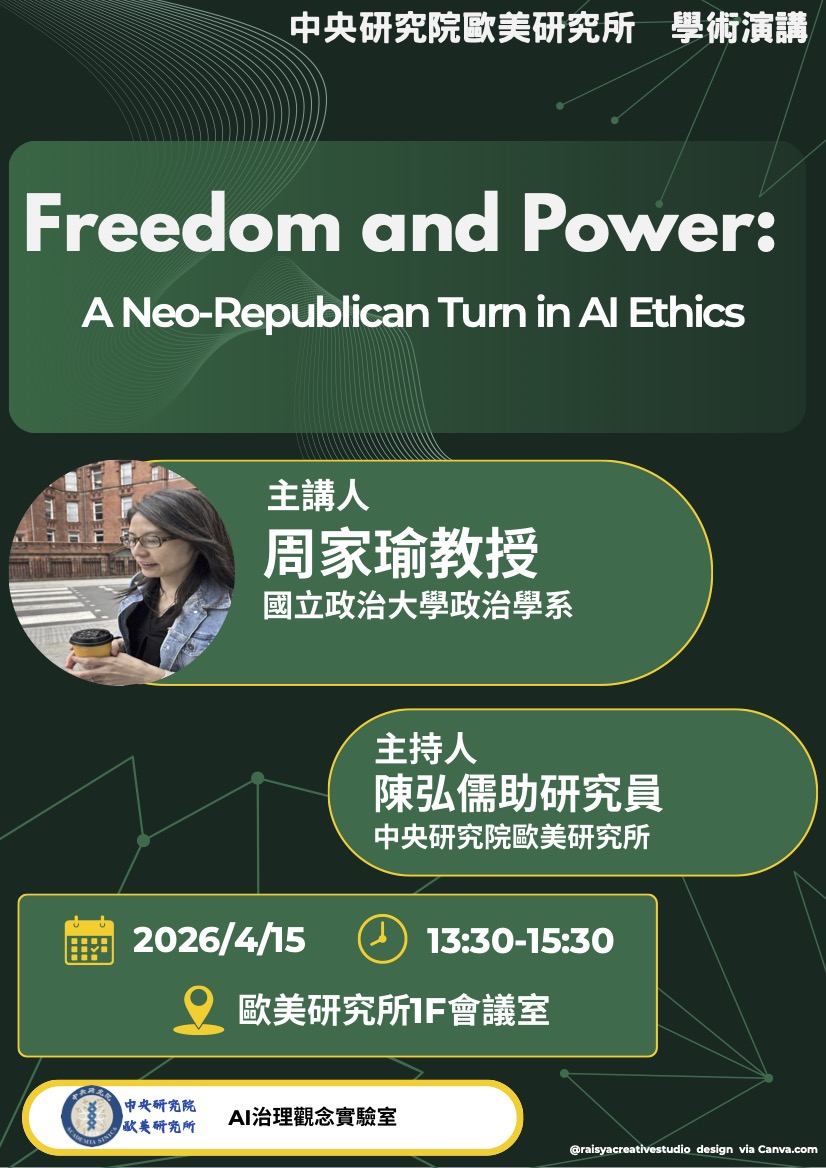
Freedom and Power: A Neo-Republican Turn in AI Ethics
本所「AI治理觀念實驗室」邀請國立政治大學政治學系周家瑜教授於2026年4月15日(星期三)下午1時30分,於本所研究大樓一樓會議室舉行演講,講題為 "Freedom and Power: A Neo-Republican Turn in AI Ethics",由本所陳弘儒助研究員主持,歡迎踴躍參加。 主講人:周家瑜教授(國立政治大學政治學系) 主持人:陳弘儒(中央研究院歐美所助研究員) Abstract: This article explores the ethical and political implications of artificial intelligence (AI) through the lens of intellectual history. Starting with a neo-republican turn in AI ethics, it poses the fundamental question: Can individuals retain freedom under such powerful technological structures? The answer, I contends, depends upon the conception of freedom adopted. Contemporary AI ethics and regulation often presuppose a liberal understanding of liberty as negative liberty (mere non-interference) which prioritises harm prevention and technical solutions to issues such as bias and discrimination. Nonetheless, this framework, rooted in Thomas Hobbes's political thought, proves inadequate for addressing the subtler forms of domination exerted by algorithmic power, including micro-domination through data collection, personalised nudges, and uncontrolled corporate influence over decision-making processes. By contrast, the republican tradition, as reconstructed by scholars such as Quentin Skinner and Philip Pettit, conceives liberty as non-domination; that is, freedom should be defined not merely from actual interference but from subjection to arbitrary power. Tracing the genealogy of these rival conceptions to the seventeenth-century debates between Hobbes and English republicans, the article indicates how Hobbes deliberately redefined liberty as absence of external impediments to render it compatible with absolute sovereignty, thereby depoliticising the concept. In sum, contextualising neo-republicanism historically reveals its superior analytical and normative resources for AI ethics. Ultimately, the article advocates shifting the focus from questions of fairness or goodness to how AI redistributes power, urging institutional designs that mitigate domination and foster genuine independence.
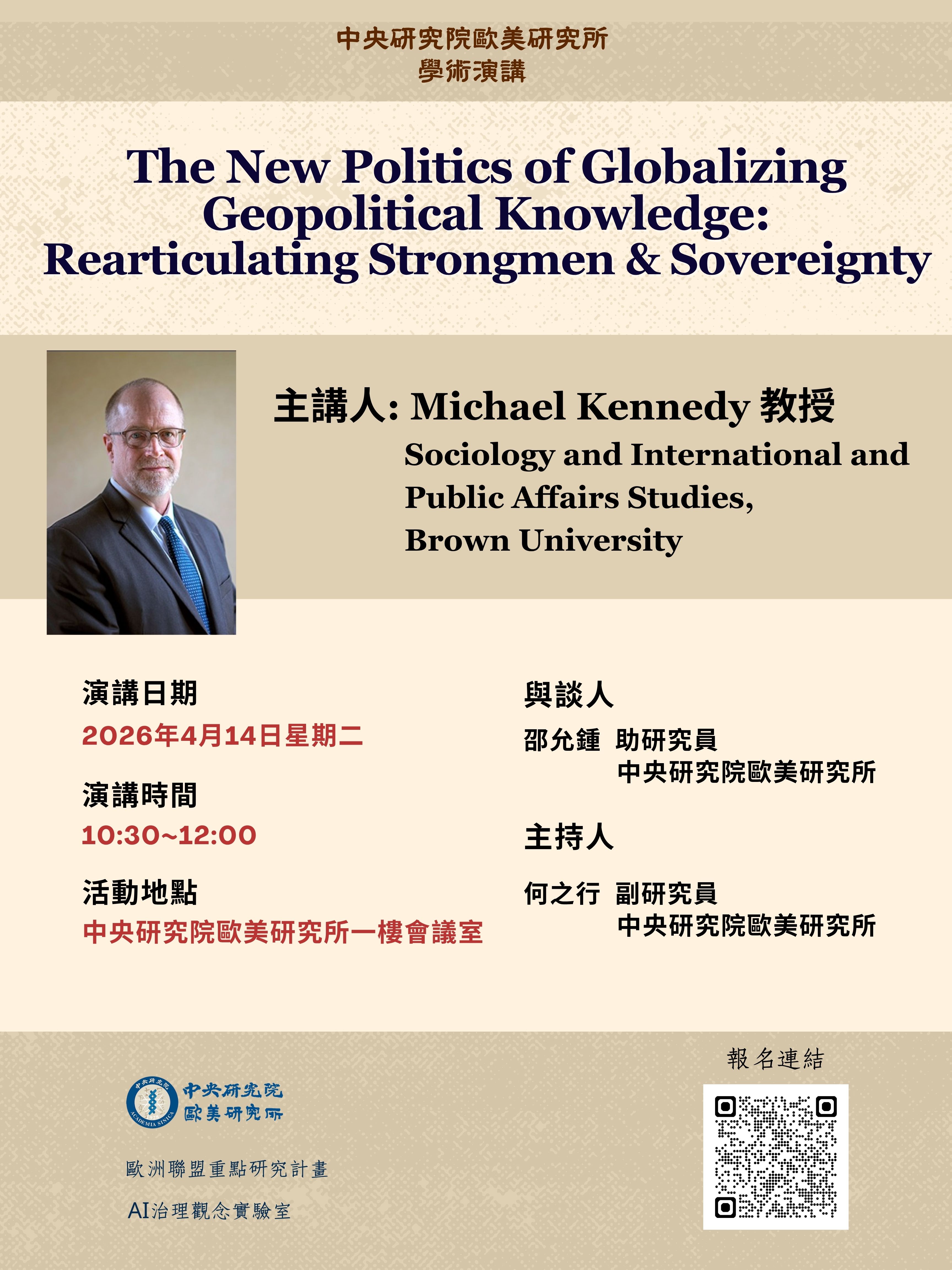
全球化地緣政治知識的新局面:強人(政治)與主權的再詮釋
本所「歐洲聯盟重點研究計畫」及「AI治理觀念實驗室」邀請Michael Kennedy教授 (Sociology and International and Public Affairs Studies, Brown University) 於民國115年4月14日(星期二)上午10時30分 於本所研究大樓一樓會議室舉行演講,講題為 “The New Politics of Globalizing Geopolitical Knowledge: Rearticulating Strongmen & Sovereignty (全球化地緣政治知識的新局面:強人(政治)與主權的再詮釋)”,歡迎踴躍參加。 主講人:Michael Kennedy教授(Sociology and International and Public Affairs Studies, Brown University) 與談人:邵允鍾(中央研究院歐美所助研究員) 主持人:何之行(中央研究院歐美所副研究員) 大綱: 過去十年的發展,在多大程度上強化或挑戰了Prof. Kennedy於2015年出版的《知識全球化》一書所提出的問題?回顧這十年,我們可以看到,人們對學術責任與大學問責的關注仍然存在。然而,美國與全球權力關係正在改變—俄羅斯入侵烏克蘭是一個明顯的例子,而強人政治在其他地區的擴散也反映了這一趨勢。這些變化正在挑戰我們對學術自由的理解,以及對多元與包容政治的看法。Kennedy以他在布朗大學的經驗為例,回顧近年的發展,並思考未來可能的方向。
2025
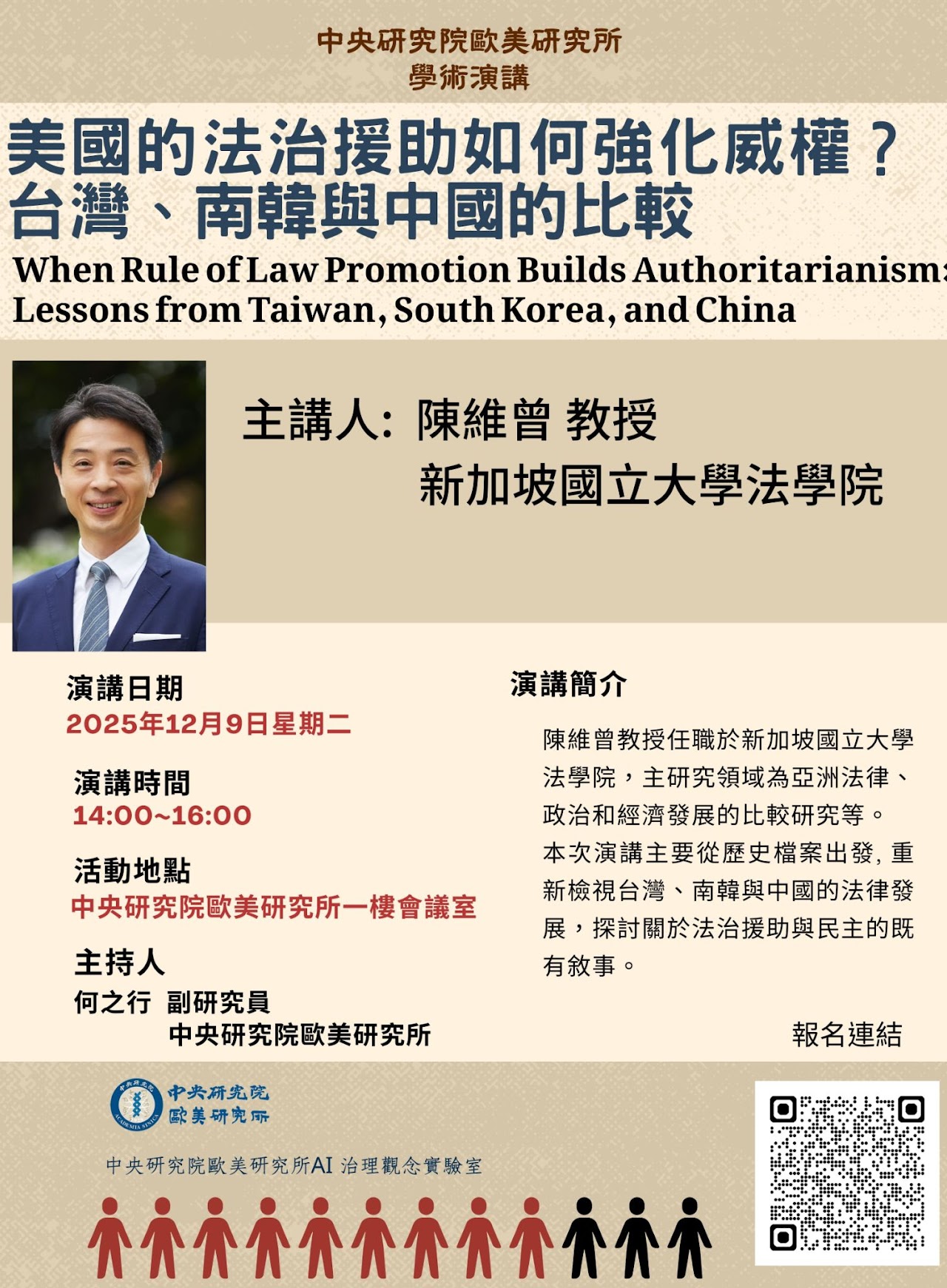
美國的法治援助如何強化威權?台灣、南韓與中國的比較
「AI治理觀念實驗室」邀請新加坡國立大學法學院陳維曾教授(Prof Weitseng Chen, National University of Singapore School of Law) 2025年12月9日 (星期二) 來所演講,由何之行副研究員主持,講題為「美國的法治援助如何強化威權?台灣、南韓與中國的比較 (When Rule of Law Promotion Builds Authoritarianism: Lessons from Taiwan, South Korea, and China)」。 大綱: 數十年來,台灣與南韓常被視為法治強化能促使威權體制邁向民主的成功典範。但為何國際社會每年投入數十億美元的法律援助, 企圖複製這個成功典範, 卻是換來過去廿年國際間的民主倒退? 本次演講從歷史檔案出發, 重新檢視台灣、南韓與中國的法律發展,挑戰關於法治援助與民主的既有敘事。研究指出,國際法治援助其實存在兩套典範:冷戰時期的「國家優先」(state-first)模式,以及冷戰後的「民主優先」(democracy-first)模式。這兩種模式在形式上不同,卻在效果上相似:國際的法治援助往往在強化而非鬆動了威權統治。台灣與南韓的民主化並非現代化理論的證據,而是例外。未來的法治援助必須重新設計,否則可能繼續成為強化威權韌性的治理工具。
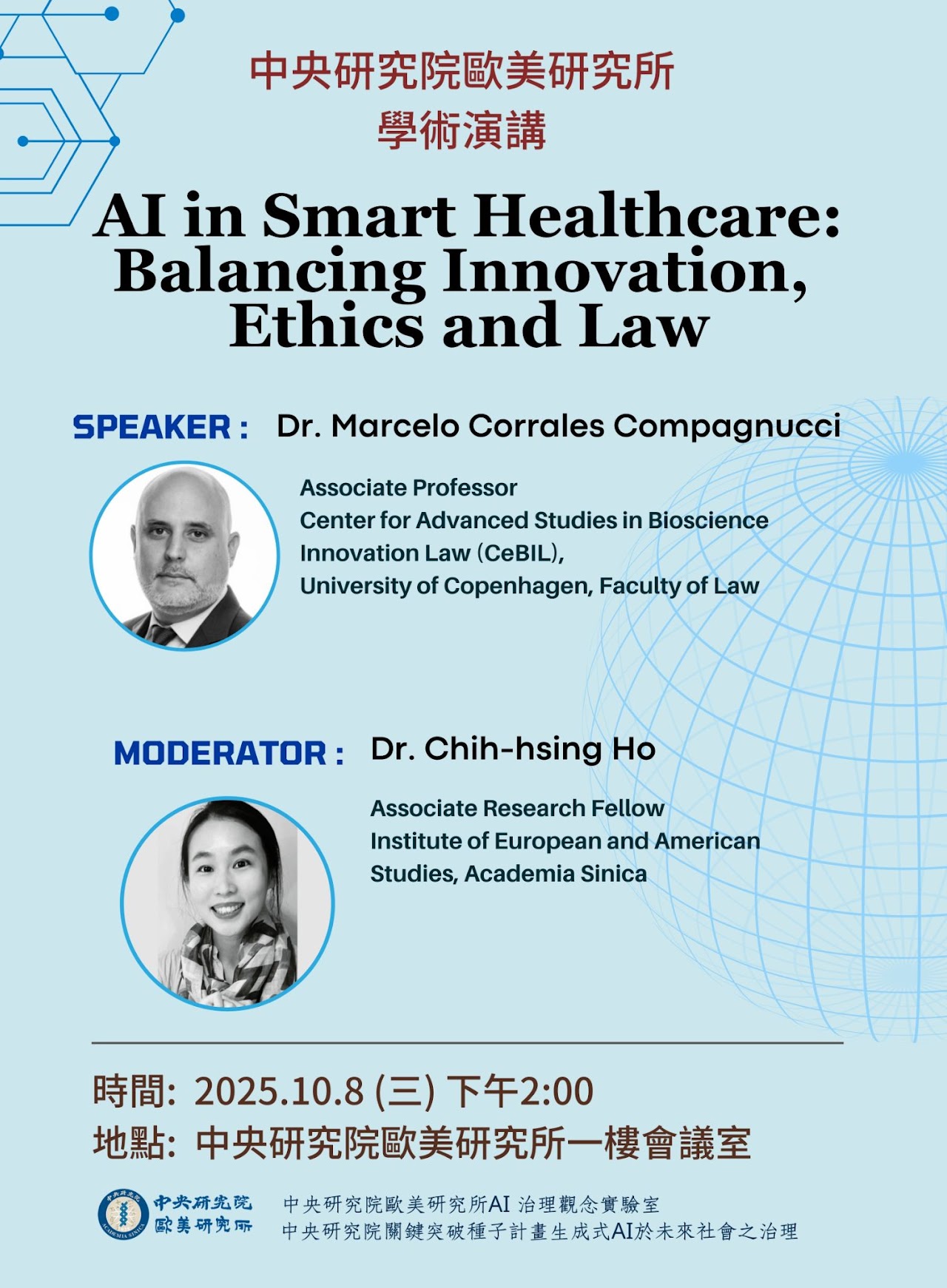
AI in Smart Healthcare: Balancing Innovation, Ethics and Law
「AI治理觀念實驗室」邀請短訪人員 Marcelo Corrales Compagnucci 博士(丹麥哥本哈根法學院副教授)2025年10月8日(星期三)來所發表演講,由何之行副研究員主持,講題為「AI in Smart Healthcare: Balancing Innovation, Ethics and Law」。 大綱: Smart healthcare is advancing rapidly, transforming hospitals into digital platforms and creating new ecosystems with startups and global technology leaders. These developments promise faster diagnoses, more personalised care and greater efficiency, but also raise urgent questions about privacy, accountability and trust. This presentation explores how innovation in AI for health is moving faster than regulation, with a focus on data protection requirements and cybersecurity standards. The session concludes with practical strategies for responsible innovation, drawing on legal and ethical guidelines as well as relevant ISO standards to support transparency, patient protection and public trust in smart healthcare ecosystems. Marcelo Corrales Compagnucci is Associate Professor and Associate Director at the Center for Advanced Studies in Bioscience Innovation Law (CeBIL), Faculty of Law, University of Copenhagen in Denmark. He is also Inter-CeBIL Research Affiliate at the Petrie-Flom Center for Health Law Policy, Biotechnology, and Bioethics at Harvard Law School. His research interests are the ethical and legal issues involved in disruptive innovation technologies and biomedicine, in particular privacy, data protection and AI governance. He is also the founder of CORCOM IT Law Consulting. He has a Doctor of Laws (LL.D.) degree from Kyushu University in Japan. He also holds a Master of Laws (LL.M.) in international economics and business law from Kyushu University, and an LL.M. in law and information technology and an LL.M. in European intellectual property law, both from the University of Stockholm in Sweden. He has several publications in the field of IT and Bioscience Law.
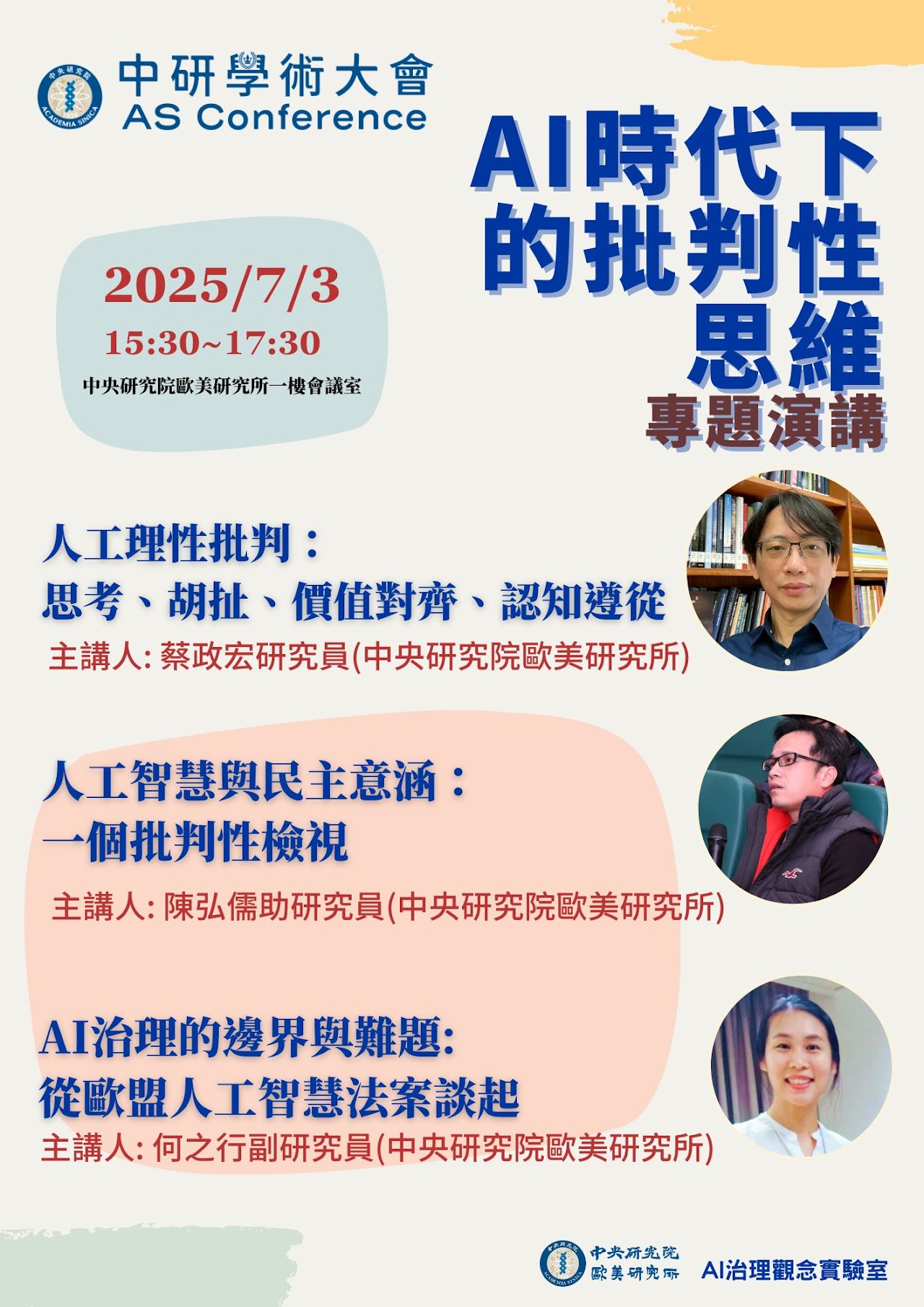
中研學術大會:AI 時代下的批判性思維
時間:2025年7月3日(星期四)下午3:30~5:30 地點:中研院歐美所一樓會議室 專題演講(一) 演講者:蔡政宏研究員 講題:人工理性批判:思考、胡扯、價值對齊、認知遵從 專題演講(二) 演講者:陳弘儒助研究員 講題:人工智慧與民主意涵:一個批判性檢視 專題演講(三) 演講者:何之行副研究員 講題:AI治理的邊界與難題: 從歐盟人工智慧法案談起 議程連結:https://drive.google.com/file/d/1E63HdUzMoOra7JL9kGWpXWwbvqKLPzdT/view
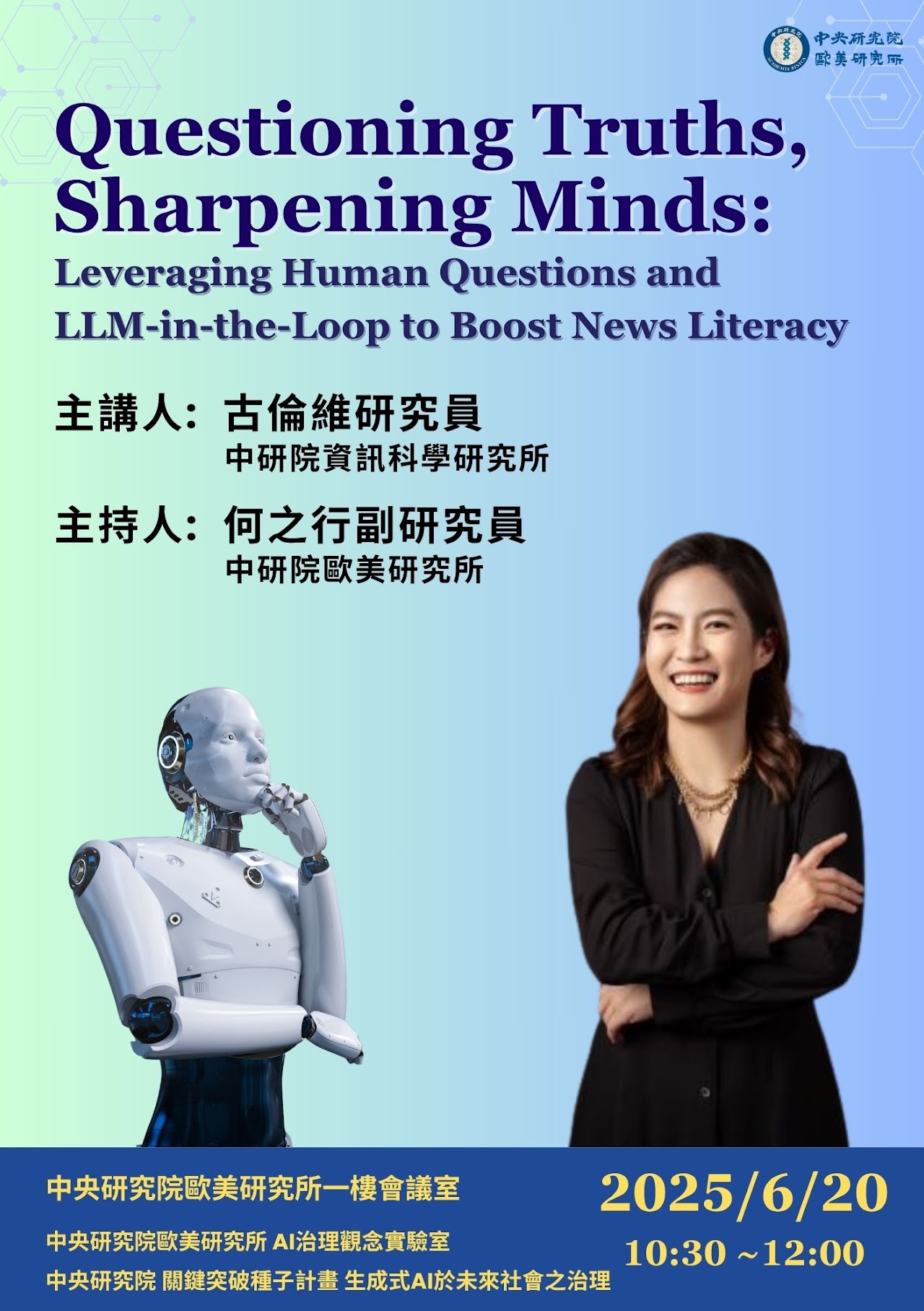
Questioning Truths, Sharpening Minds: Leveraging Human Questions and LLM-in-the-Loop to Boost News Literacy
講題:「Questioning Truths, Sharpening Minds: Leveraging Human Questions and LLM-in-the-Loop to Boost News Literacy」 講者:中央研究院資訊科學研究所古倫維研究員 主持人:何之行副研究員 大綱:Fake news is not just a technological problem—it’s a cognitive challenge. This talk presents an interactive system that leverages human inquiry to iteratively enhance explanations provided by a large language model for questionable news stories. By treating explanation generation as a dialogue, the system encourages users to ask clarifying questions, raise objections, and offer comments, prompting the AI to refine its responses in real time. With each round of Q&A, the explanations become increasingly complete, transparent, and tailored to users’ concerns. Our findings reveal that this question-driven process significantly shapes explanations. Thoughtful questions can help uncover the truth behind false claims—highlighting inconsistencies and providing enlightening context to debunk misinformation. Although the AI’s responses, influenced by its underlying knowledge and reasoning abilities, could potentially lead to misunderstandings, the overall risk of harm remains minor. Ultimately, the interactive questioning process significantly enhances the persuasiveness and clarity of generated explanations. Looking forward, we envision the system becoming a hands-on educational tool. In classroom settings, it can serve as a debate partner, presenting controversial news claims and engaging students in lively Q&A exchanges. The system actively prompts students to challenge AI statements, demand evidence, and identify logical fallacies, fostering essential news literacy skills. For students unfamiliar with debate practices, the AI can also demonstrate an automated argumentative process, serving as a helpful teaching assistant. This playful yet informative format transforms passive news consumption into active critical investigation, making lessons about misinformation both enjoyable and impactful. 時間:2025年6月20日(星期五)上午10:30 地點:中研院歐美所一樓會議室
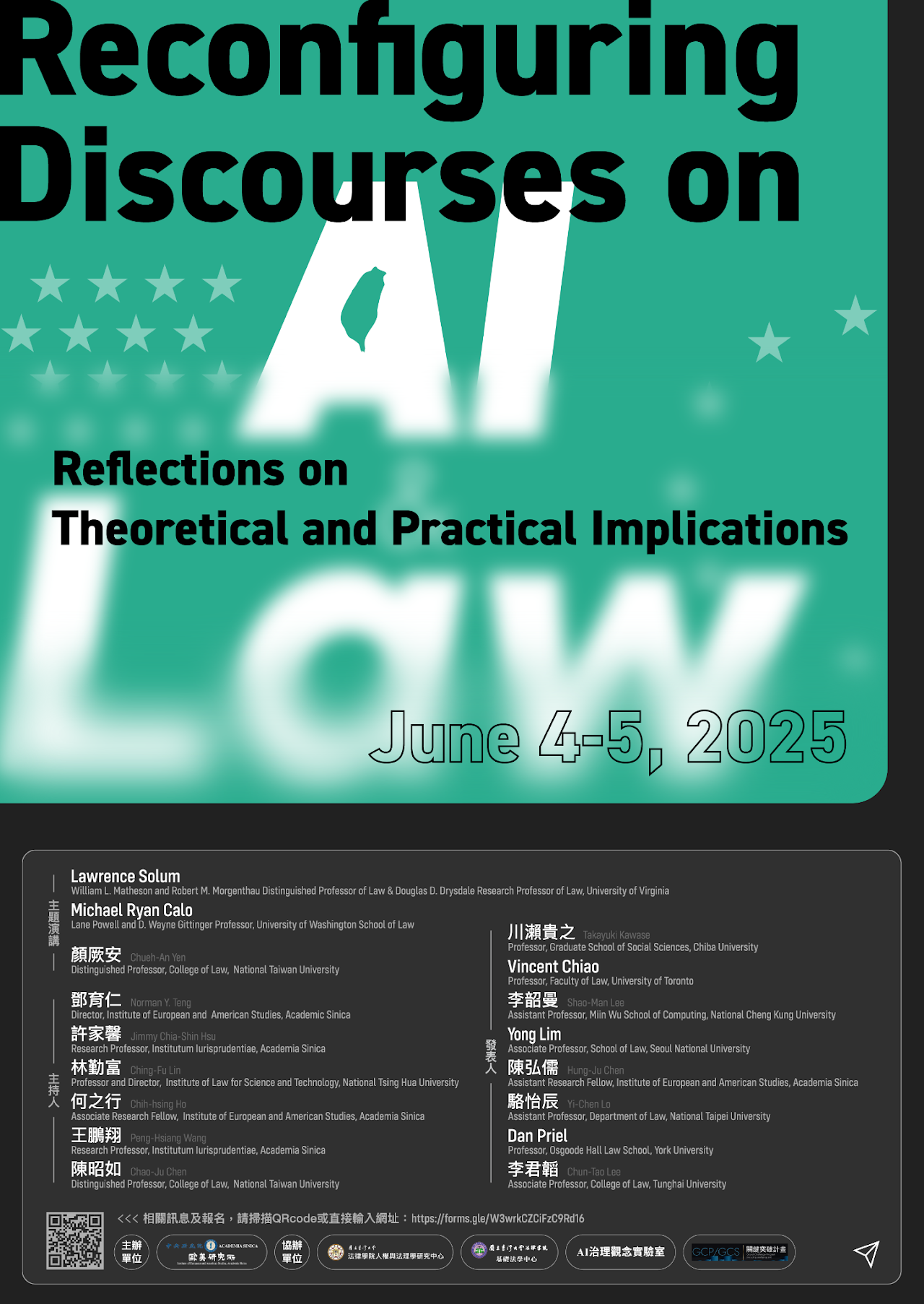
Reconfiguring Discourses on AI & Law: Reflections on Theoretical and Practical Implications國際研討會
時間:2025年6月4-5日(星期三~星期四) 地點:中研院歐美所一樓會議廳 秘書長:陳弘儒
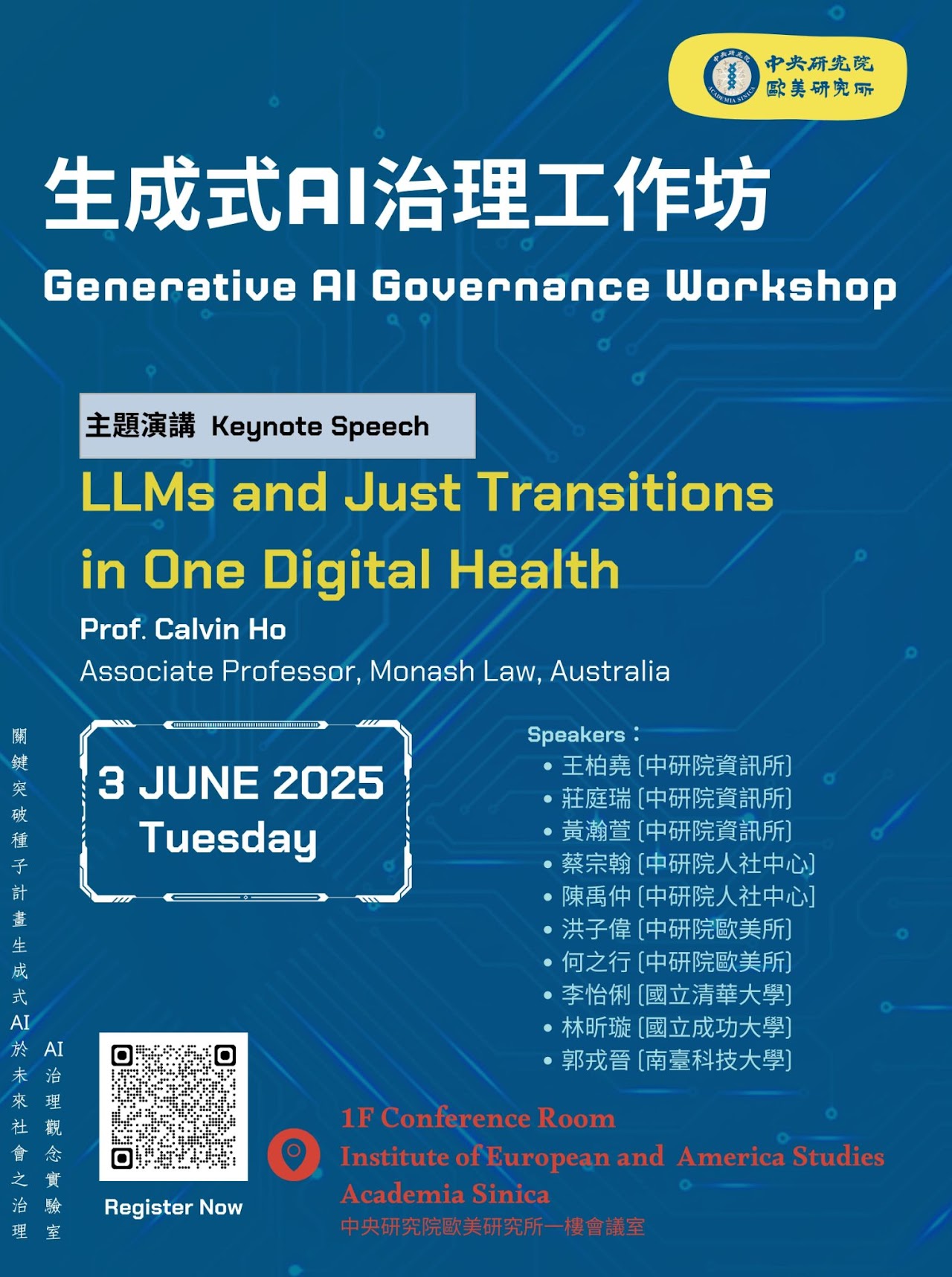
生成式 AI 治理工作坊
時間:2025年6月3日(星期二) 地點:中研院歐美所一樓會議廳 主題演講人:Prof. Calvin Ho(蒙納許大學法學院副教授) 講題:「LLMs and Just Transitions in One Digital Health」 演講人包含:中研院資訊科學研究所王柏堯研究員、莊庭瑞副研究員、黃瀚萱副研究員、中研院人社中心蔡宗翰研究員與陳禹仲副研究員、國立清華大學科技法律研究所李怡俐副教授、國立成功大學政治學系林昕璇助理教授、南臺科技大學財經法律研究所郭戎晉副教授、與本所洪子偉研究員、何之行副研究員等,共同探討「生成式AI治理」相關議題。 議程連結:<a href="https://www.ea.sinica.edu.tw/Admin/ashx/GetFile.ashx?ID=57052" target="_blank" rel="noopener noreferrer">https://www.ea.sinica.edu.tw/Admin/ashx/GetFile.ashx?ID=57052</a>
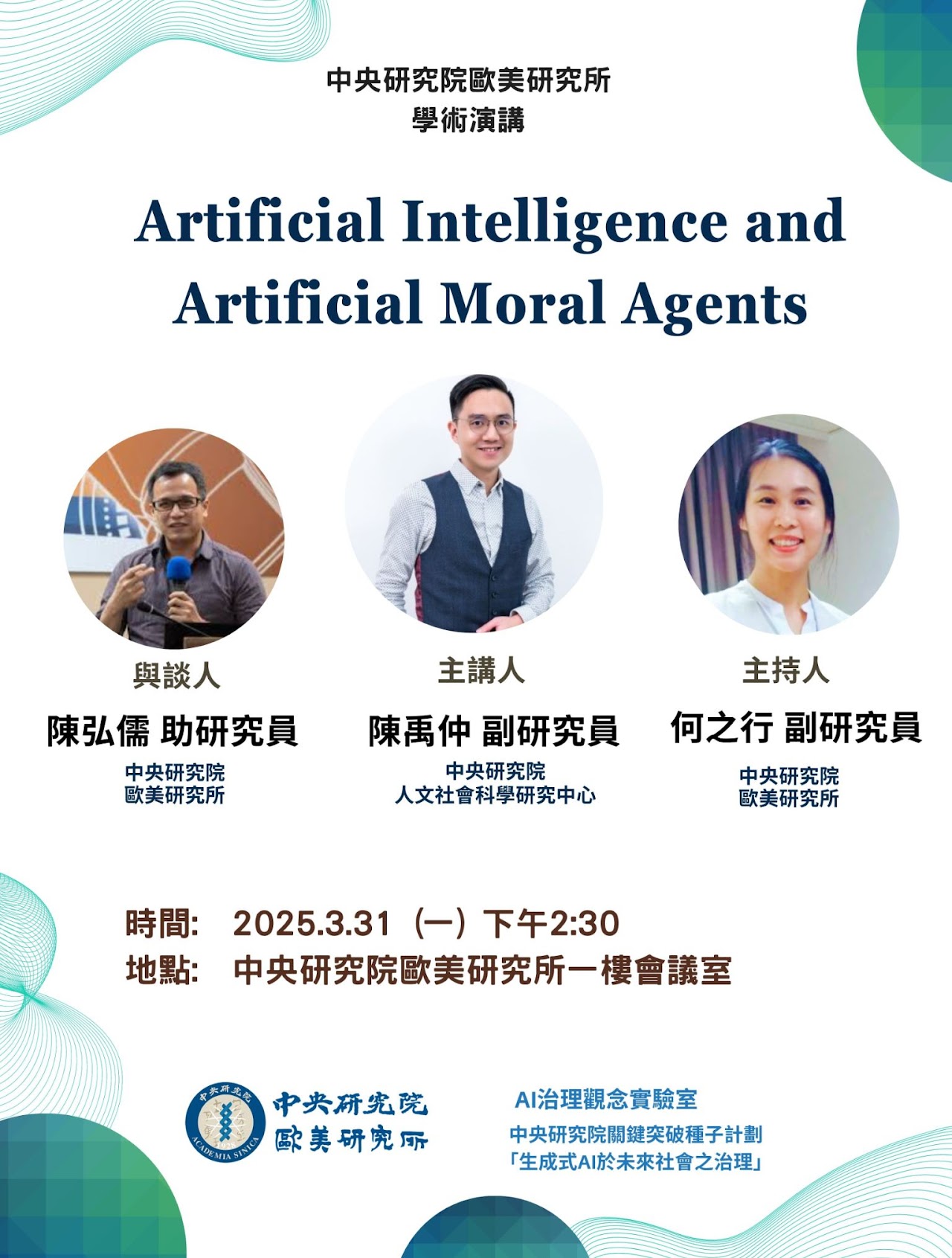
Artificial Intelligence and Artificial Moral Agents
講題:「Artificial Intelligence and Artificial Moral Agents」 講者:中央研究院人文社會科學研究中心陳禹仲副研究員 主持人:何之行副研究員 與談人:陳弘儒助研究員 大綱:With the recent development of generative artificial intelligence, questions like “Can AI be responsible of its wrongs?” and “if can, how?” become increasingly pressing; the so-called “responsibility gap”. These questions are mostly framed in terms familiar to the field of machine ethics, a field of studies emphasizing ethical reflections on the development of machines. But conceptions of artificial agent with moral capacity in legal and political theory predates the emergence of machine ethics and the development of generative AI. This paper argues that the so-called “responsibility gap” exists only because of the account of artificial agent in machine ethics. It shows that, once insights from legal and political philosophy are taken, there will be a much clearer understanding of the characters of artificial moral agents and a less troubling undertaking of the responsibility of AI. In terms of specifics, the paper addresses the following tripartite question: Is AI an artificial moral agent? If it is, what kind of artificial moral agent is it? Why does it matter for AI to be an artificial moral agent? An answer to the third part of this question quintessentially presents a response to the “responsibility gap” by reassessing how AI can take responsibility. The paper concludes with reflections on its practical implications, notably to AI in medicine. Keywords: Artificial Intelligence (AI), Artificial Moral Agents (AMAs), responsibility gap, rational belief, relational responsibility 時間:2025年3月31日(星期一)下午2:30 地點:中研院歐美所一樓會議室
2024
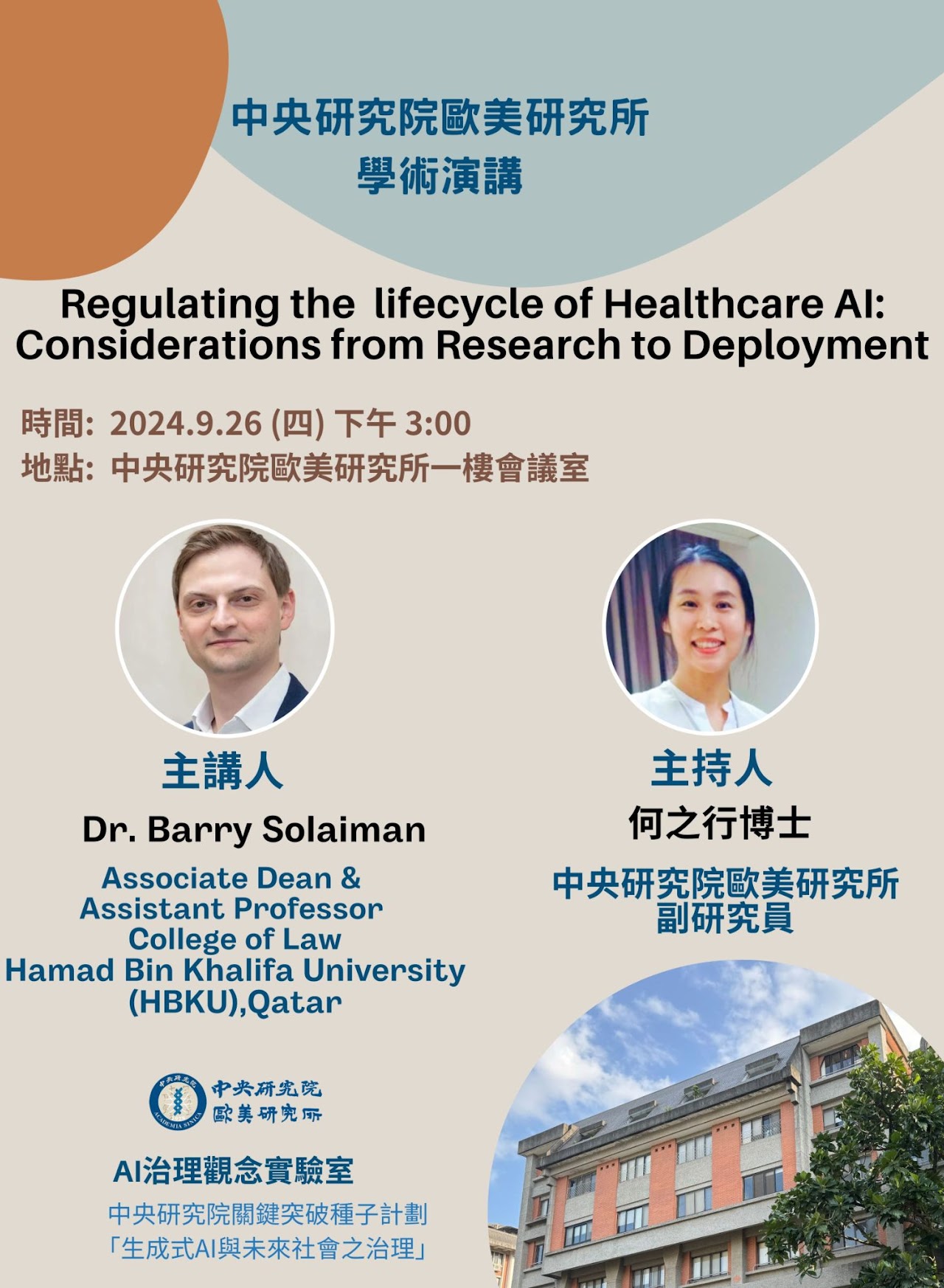
Regulating the lifecycle of Healthcare AI: Considerations from Research to Deployment
講題:「Regulating the lifecycle of Healthcare AI: Considerations from Research to Deployment」 講者:Dr. Barry Solaiman (Associate Dean & Assistant Professor College of Law Hamad Bin Khalifa University, HBKU, Qatar) 主持人:何之行副研究員 Abstract: This talk addresses the comprehensive regulation of artificial intelligence (AI) across its entire lifecycle in the healthcare sector. Beginning with the research phase, it highlights the urgent need for robust guidelines and certification processes to ensure that AI technologies are developed in compliance with ethical and safety standards. Moving into the approval stage, the discussion explores how AI systems can be effectively regulated under existing medical device frameworks, emphasising the need for tailored regulations that consider the unique challenges posed by AI. Finally, the talk delves into the deployment of AI in clinical practice, examining the gaps in current laws and the pressing need for a coherent and consistent regulatory framework that can adapt to the rapid advancements in AI technology. The talk argues that the existing legal structures are inadequate, often inconsistent, and fail to address the complexities of AI in healthcare, making the case for a comprehensive overhaul of regulatory approaches to ensure patient safety, efficacy, and ethical integrity throughout the AI lifecycle. 時間:2024年9月26日(星期四)下午3:00 地點:中研院歐美所一樓會議室
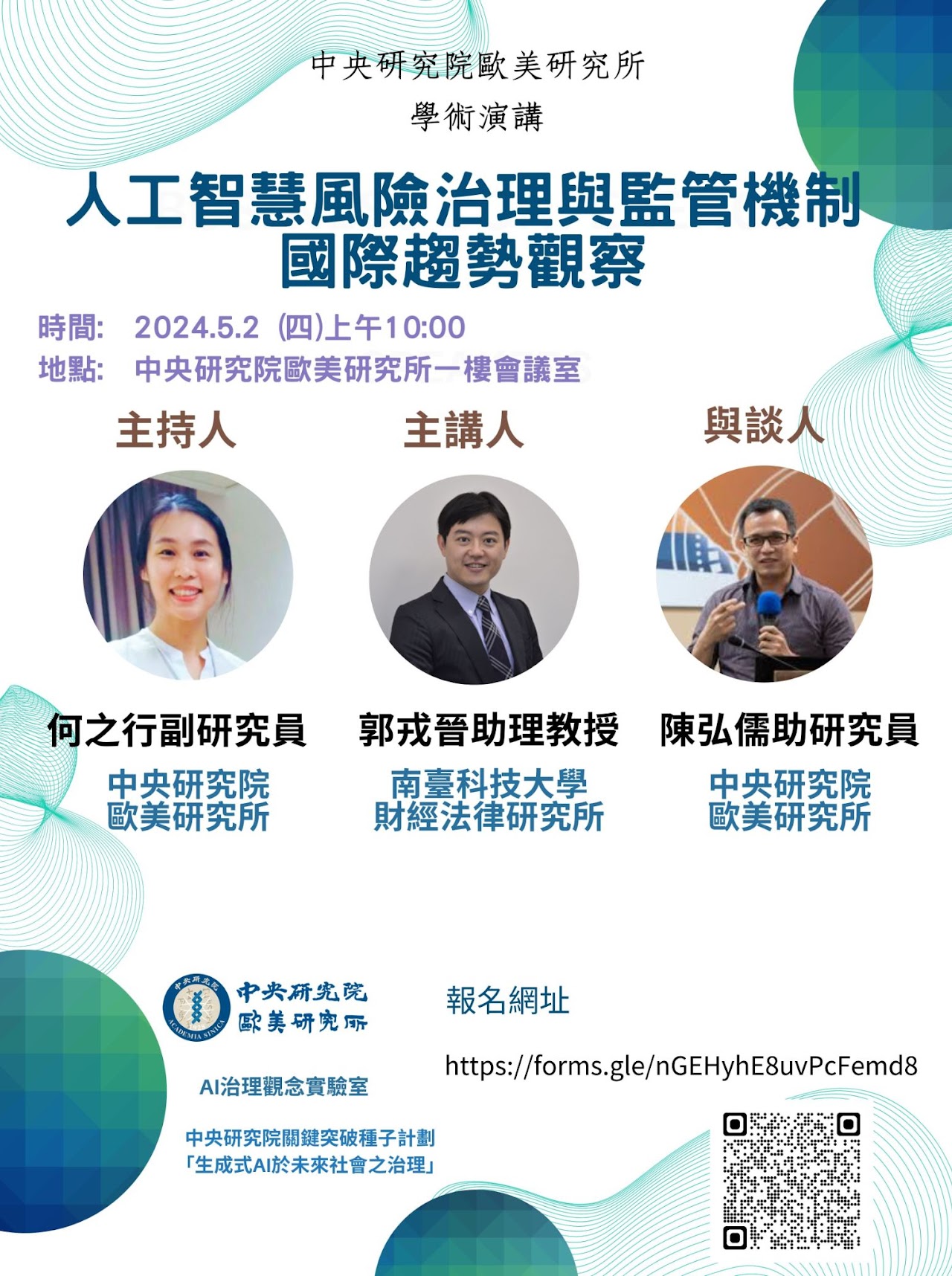
人工智慧風險治理與監管機制國際趨勢觀察
講題:「人工智慧風險治理與監管機制國際趨勢觀察」 講者:南臺科技大學財經法律研究所助理教授 郭戎晉博士 主持人:何之行副研究員 與談人:陳弘儒助研究員 大綱:隨著人工智慧應用領域的拓展與多元化,此一嶄新技術引發的問題也隨之增加。在風險漸增下,人工智慧的監管思維已由初期的自律為主,逐步向他律靠攏並有轉為以他律為重之趨勢。本次演講將分享國際人工智慧風險治理發展脈絡、趨勢以及現時主要國家在人工智慧監管機制推動上之差異,進而思考我國之現況、相應立場與所應審慎思考的課題。 時間:2024年5月2日(星期四)上午10:00 地點:中研院歐美所一樓會議室
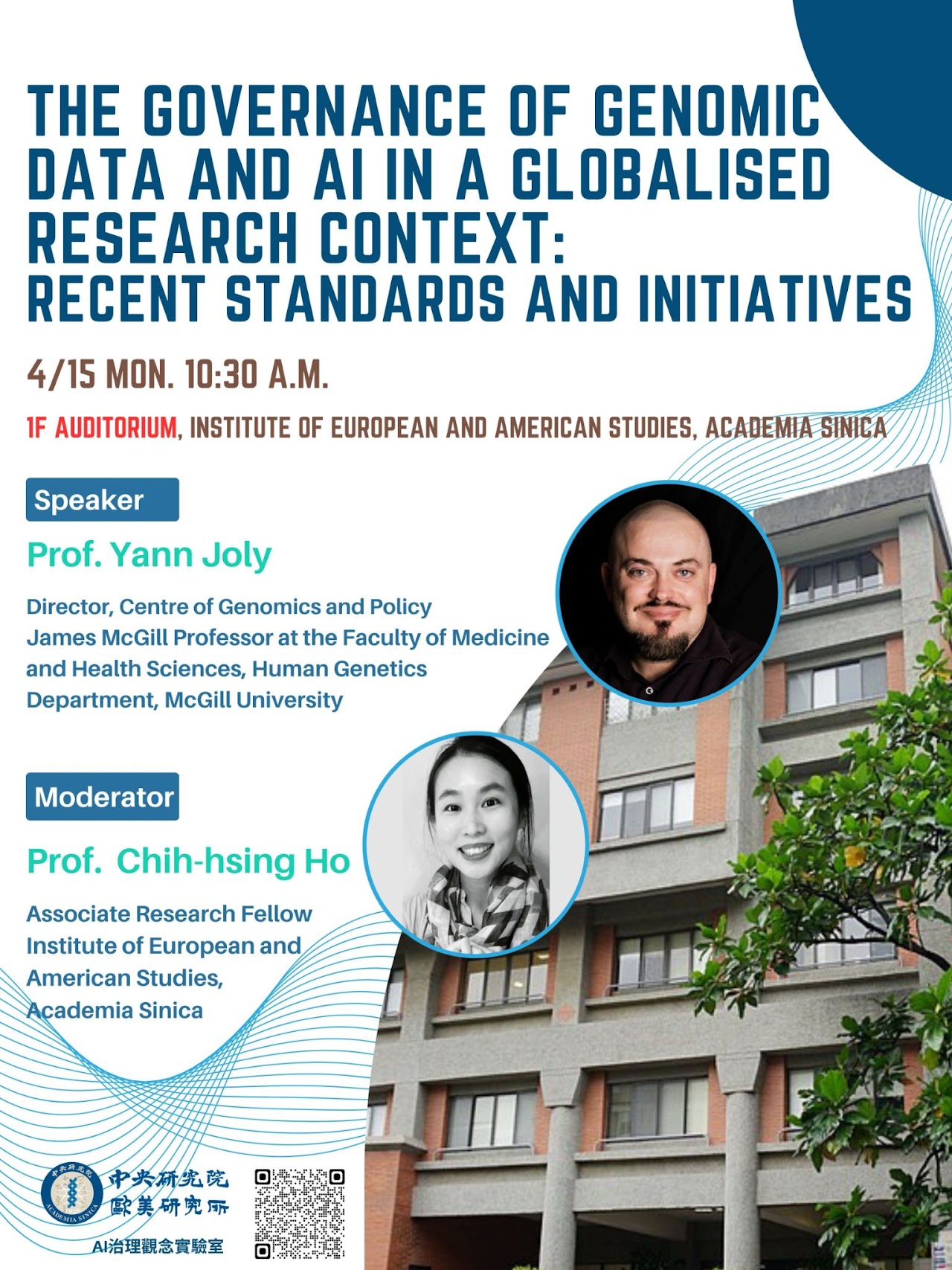
The Governance of Genomic Data and AI in a Globalised Research Context: Recent Standards and Initiatives
講題:「The Governance of Genomic Data and AI in a Globalised Research Context: recent standards and Initiatives」 講者:McGill大學James McGill教授暨基因組政策中心主任 Yann Joly教授 主持人:何之行副研究員 大綱: Over the last two decades, genomic science and technologies have achieved important breakthrough whose effect have started to impact patient care. Given this success, biobanks and genomic database projects have multiplied in numbers and grown in scope. These large genomic research projects now store petabytes of data on the cloud. These projects require a well thought out governance structure to ensure that they are legally compliant, ethically sound and, ideally positioned to yield public benefits. International organizations, new and old, such as the World Health Organization, the UNESCO International Bioethics Committee, The Global Alliance for Genomics and Health and the International Society for Biological and Environmental Repository (ISBER) have sought to provide these new kinds of research projects policy frameworks and guidance on good practices for genomic projects. The current presentation will focus on recent initiatives to tackle three major developments faced by genomic researchers: 1) streamlining the data visiting governance model, 2) developing meaningful policies to address the challenges raised using AI in genomics and, 3) points to consider for achieving greater diversity in genomics datasets. It will identify the stage of development of these initiatives, possibilities for researchers to get involved, and will present the policies and tools that are already available for the community to use. 時間:2024年4月15日(星期一)上午10:30 地點:中研院歐美所一樓大禮堂
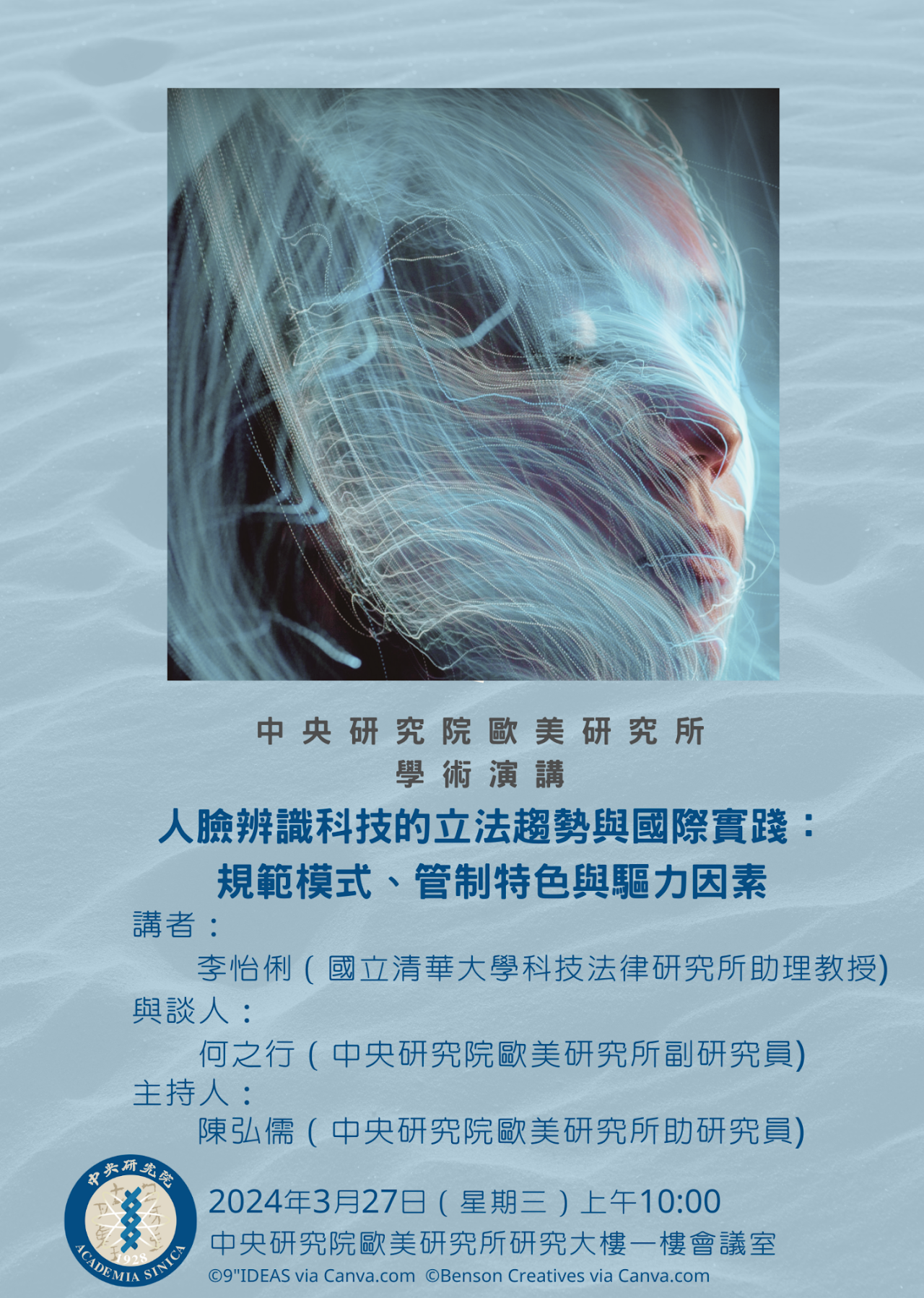
人臉辨識科技的立法趨勢與國際實踐:規範模式、管制特色與驅力因素
講題:「人臉辨識科技的立法趨勢與國際實踐:規範模式、管制特色與驅力因素」 講者:國立清華大學科技法律研究所助理教授 李怡俐博士 主持人:陳弘儒助研究員 與談人:何之行副研究員 時間:2024年3月27日(星期三)上午10:00 地點:中研院歐美所一樓會議室
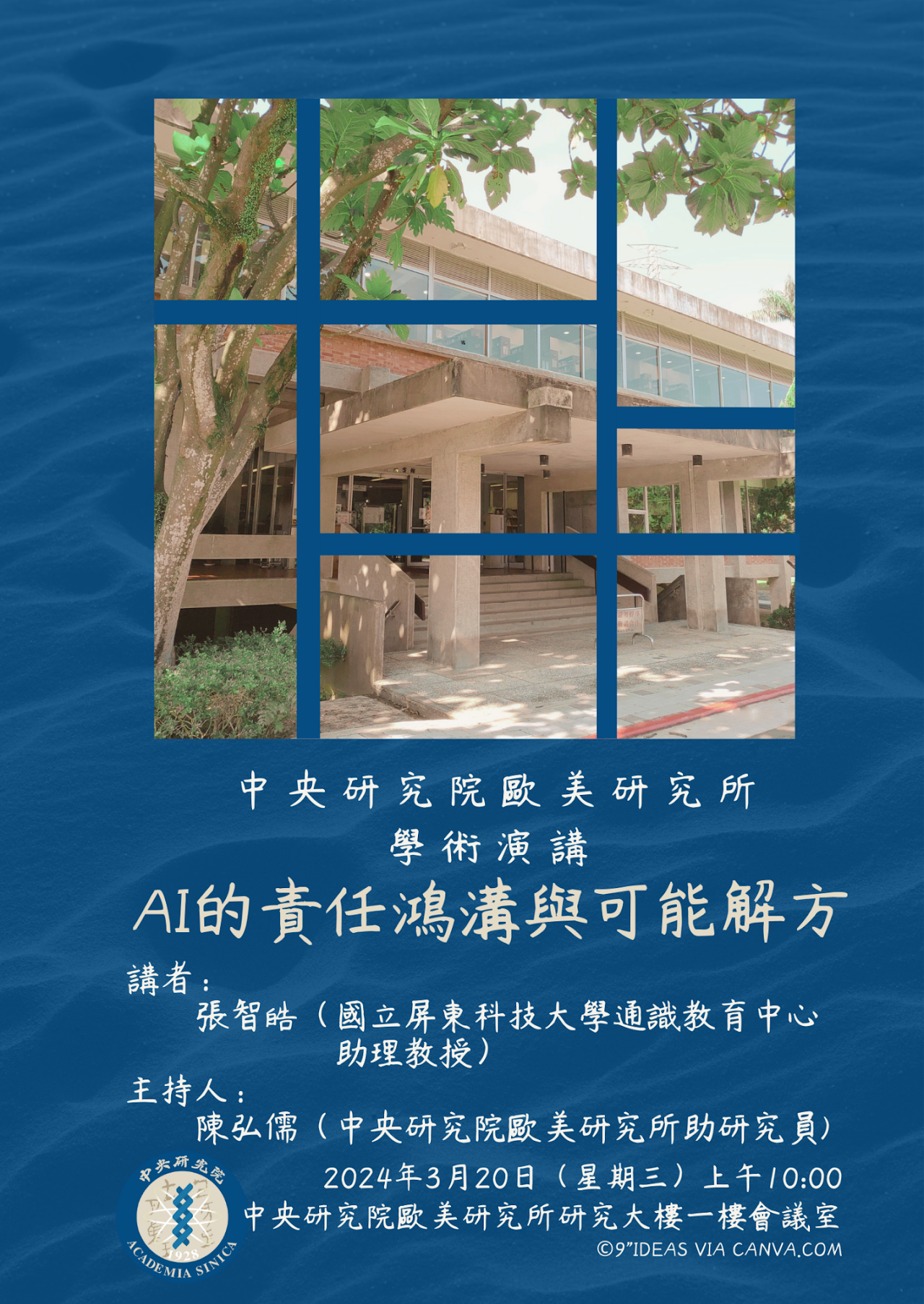
AI的責任鴻溝與可能解方
講題:「AI的責任鴻溝與可能解方」 講者:國立屏東科技大學通識教育中心助理教授 張智皓博士 主持人:陳弘儒助研究員 時間:2024年3月20日(星期三)上午10:00 地點:中研院歐美所一樓會議室