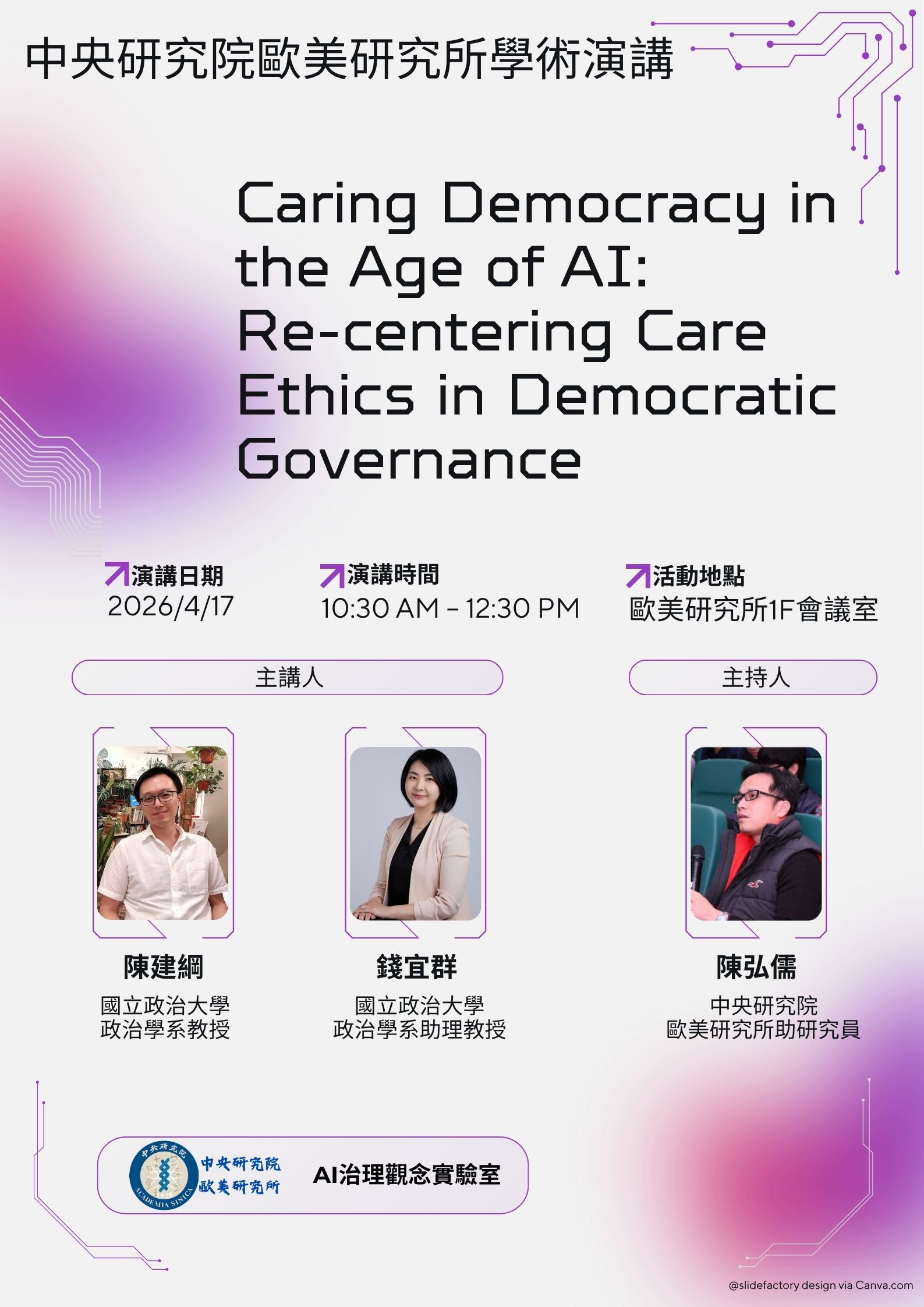
Caring Democracy in the Age of AI: Re-centering Care Ethics in Democratic Governance
Speakers: Brian Chen (Professor, Department of Political Science, National Chengchi University)
Yi-Chun Chien (Assistant Professor, Department of Political Science, National Chengchi University)
Moderator: Dr. Hung-ju Chen (Assistant Research Fellow, Institute of European and American Studies, Academia Sinica)
Time: 10:30 A.M. Friday, April 17, 2026.
Venue: 1st Floor Conference Room, Institute of European and American Studies, Academia Sinica
Abstract: This paper reinterprets democratic governance through the lens of care ethics, exploring whether artificial intelligence can fix—or instead worsen—the ongoing "care deficit" that liberal democracies have long experienced. Drawing on the care ethics literature, we contend that liberal-procedural models of democracy render dependency, interdependence, and vulnerability over time politically invisible, while shifting care responsibilities into gendered and racialized labor markets. They also valorize participatory citizenship that caregivers often lack time for and normalize market-based substitutes for public care.
By integrating care ethics with procedural democratic theory, we show how procedural elements, often seen as ideal, tend to prioritize rational autonomy and discursive equality while neglecting the embodied, emotional, and temporal aspects of political life. We contend that a democracy attentive to care must expand its normative focus beyond procedural inclusion to emphasize relational responsiveness. To address these gaps, we propose four care-centered democratic capacities—attentiveness, responsibility, competence, and responsiveness—along with answerability, as criteria for assessing institutions, technologies, and accountability measures. We also develop a care-ethical framework for design and oversight that involves co-design with caregivers, public-interest data infrastructures, algorithmic impact assessments aligned with due process, and time-based social rights such as care income or care credits. The paper concludes with a reform agenda for care-oriented AI and democratic renewal, stressing that only by re-centering care can democracies resist the dehumanizing effects of technological automation competition.
Keywords: care ethics; procedural democracy; AI governance; democratic repair; social reproduction