Governance of
Generative AI in the Future Society
Engaging in the governance of Generative AI, enriching global discussions on AI governance through a dialogue between global norms and local forms.
Activities & News
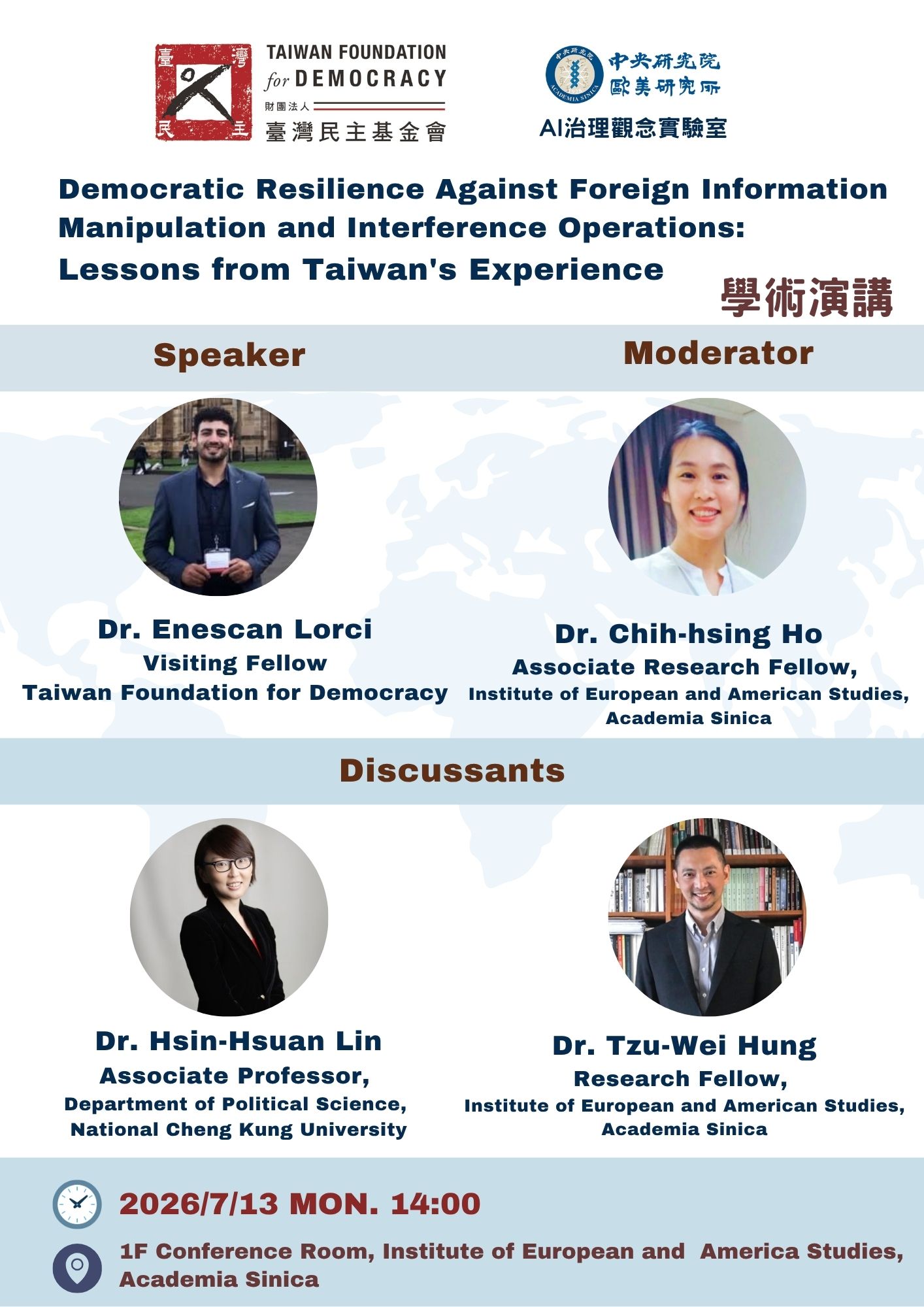
Democratic Resilience Against Foreign Information Manipulation and Interference Operations: Lessons from Taiwan's Experience
Co-hosted by the IEAS "AI Governance" Concept Lab and the Taiwan Foundation for Democracy. Speaker: Enescan Lorci, PhD (Visiting Fellow, Taiwan Foundation for Democracy) Discussants: Dr. Tzu-Wei Hung (Research Fellow, IEAS, Academia Sinica), Prof. Hsin-Hsuan Lin (Associate Professor, National Cheng Kung University) Moderator: Dr. Chih-Hsing Ho (Associate Research Fellow, IEAS, Academia Sinica) Time: 2:00 P.M. Monday, July 13, 2026. Venue: 1st Floor Conference Room, Institute of European and American Studies, Academia Sinica

Ethical Design and Standardization in Robot Governance
Speakers: Yueh-Hsuan WENG (Associate Professor, Institute for Advanced Study, Kyushu University) Moderator: Dr. Chih-Hsing Ho (Associate Research Fellow, Institute of European and American Studies, Academia Sinica) Time: 10:30 A.M. Monday, May 4, 2026. Venue: 1st Floor Conference Room, Institute of European and American Studies, Academia Sinica Abstract: This presentation will explore the application of artificial intelligence (AI) ethical standards in the governance of intelligent robots. Specifically, it will focus on analyzing the widely discussed "AI Pacing Problem" and the feasibility of applying AI ethical standards. In addition to discussing the current application of robotics in Japanese society, this presentation also advocates for establishing a non-binding and flexible regulatory framework for human-robot interaction to ensure that stakeholders can manage the inherent ethical, legal, and social (ELSI) risks in everyday human-robot interactions. By incorporating AI ethical standards into the development process of humanoid and social robots, robot developers can integrate responsible innovation and research principles into soft law-based governance without conflicting with existing "hard laws" governing robots. This presentation will explore ethical robot design methodologies through two case studies, analyzing their potential and limitations.
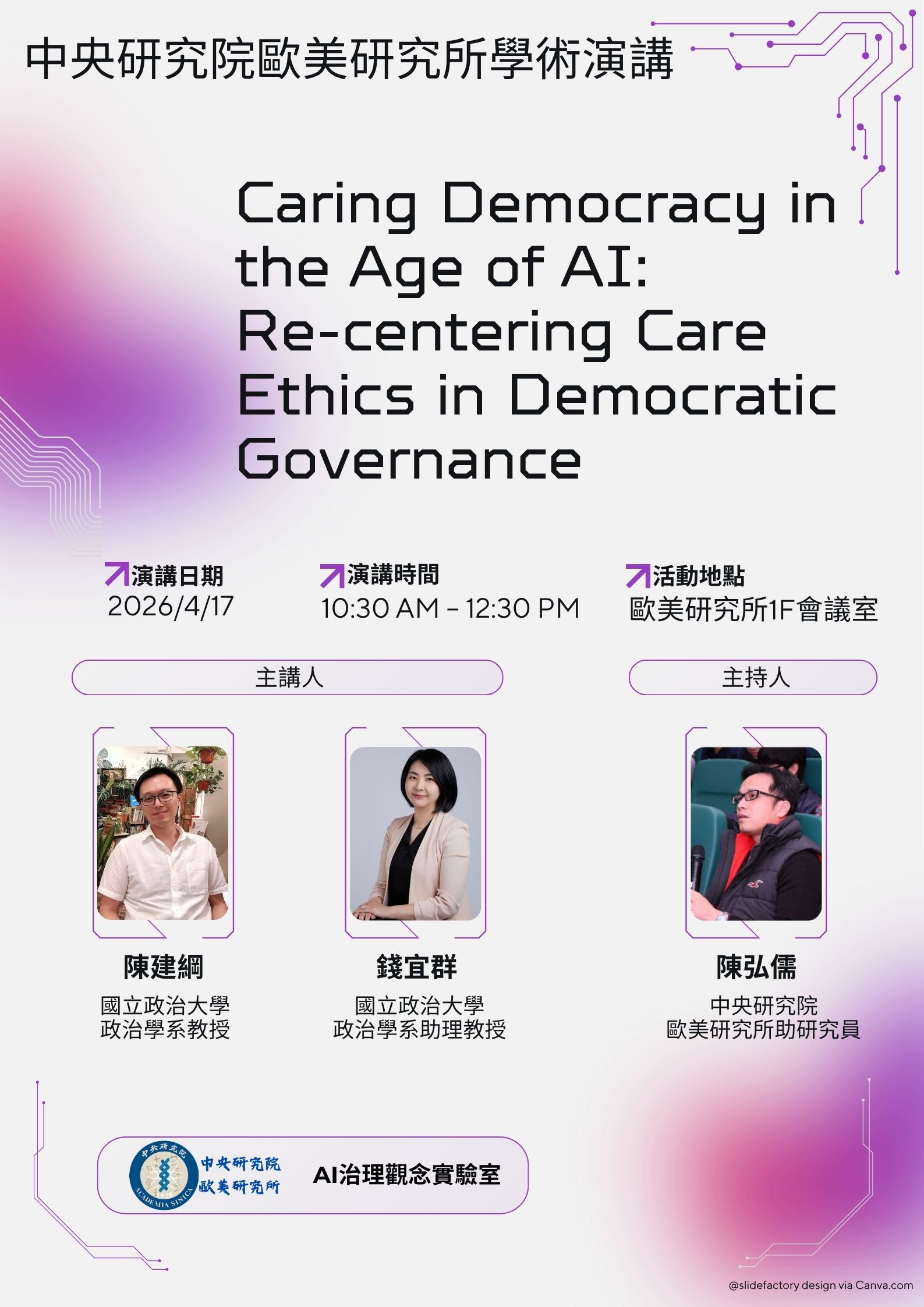
Caring Democracy in the Age of AI: Re-centering Care Ethics in Democratic Governance
Speakers: Brian Chen (Professor, Department of Political Science, National Chengchi University) Yi-Chun Chien (Assistant Professor, Department of Political Science, National Chengchi University) Moderator: Dr. Hung-ju Chen (Assistant Research Fellow, Institute of European and American Studies, Academia Sinica) Time: 10:30 A.M. Friday, April 17, 2026. Venue: 1st Floor Conference Room, Institute of European and American Studies, Academia Sinica Abstract: This paper reinterprets democratic governance through the lens of care ethics, exploring whether artificial intelligence can fix—or instead worsen—the ongoing "care deficit" that liberal democracies have long experienced. Drawing on the care ethics literature, we contend that liberal-procedural models of democracy render dependency, interdependence, and vulnerability over time politically invisible, while shifting care responsibilities into gendered and racialized labor markets. They also valorize participatory citizenship that caregivers often lack time for and normalize market-based substitutes for public care. By integrating care ethics with procedural democratic theory, we show how procedural elements, often seen as ideal, tend to prioritize rational autonomy and discursive equality while neglecting the embodied, emotional, and temporal aspects of political life. We contend that a democracy attentive to care must expand its normative focus beyond procedural inclusion to emphasize relational responsiveness. To address these gaps, we propose four care-centered democratic capacities—attentiveness, responsibility, competence, and responsiveness—along with answerability, as criteria for assessing institutions, technologies, and accountability measures. We also develop a care-ethical framework for design and oversight that involves co-design with caregivers, public-interest data infrastructures, algorithmic impact assessments aligned with due process, and time-based social rights such as care income or care credits. The paper concludes with a reform agenda for care-oriented AI and democratic renewal, stressing that only by re-centering care can democracies resist the dehumanizing effects of technological automation competition. Keywords: care ethics; procedural democracy; AI governance; democratic repair; social reproduction
Our Mission
"by returning AI to a human-centric approach and establishing trustworthy AI through governance, while responding to the potential impacts of AI technology on civilization and democratic society."
以生成式 AI 之未來治理為主題進行跨領域研究。
AI Challenges & Impact
The rapid advancement of AI comes with significant challenges to human civilization, social norms, economic structures, and even the core values of democracy and the rule of law.
In recent years, with the rapid development of artificial intelligence (AI) technology, AI has profoundly affected various aspects of our lives. Towards the end of 2022, the emergence of Generative Artificial Intelligence (Generative AI) along with large language models (LLMs) has brought about extensive applications in areas such as natural language processing, image generation, and AI manufacturing, ushering in a new era of AI development. However, the rapid advancement of AI also comes with significant challenges to human civilization, social norms, economic structures, and even the core values of democracy and the rule of law. Increasing societal polarization driven by algorithms, digital surveillance and targeted advertising, the spread of fake news, and the misuse of deepfake technology are some of the critical challenges. The primary goal of this laboratory's establishment is to address these challenges by returning AI to a human-centric approach and establishing trustworthy AI through AI governance, while responding to the potential impacts of AI technology on civilization and democratic society.
Trustworthy AI & Research Innovation
Addressing these challenges by returning AI to a human-centric approach and establishing trustworthy AI through governance, while responding to the potential impacts of AI technology on civilization and democratic society.
The establishment of the AI Governance Laboratory in our Institute of European and American Studies aims to conduct extensive and in-depth research on critical issues related to AI governance. This includes topics ranging from digital privacy, data protection and data governance, algorithm transparency and explainability, exploration of causality in automated decision-making, cognitive science and bias mitigation, human knowledge and wisdom reflection, human-robot interaction and responsibility allocation, as well as the establishment of AI ethics and norms. We hope to adopt a more open and diverse attitude, drawing on perspectives from various disciplines, including law, jurisprudence, cognitive philosophy, epistemology, ethics, and information science. Through interdisciplinary academic dialogues, we aim to establish horizontal connections to contemplate essential issues in AI governance. This research approach, by introducing different social contexts, actors, structures, and cultures, will create novel and original European and American studies through comparison, dialogue, and translation. These perspectives and dimensions will enrich traditional Euro-American studies, which are mainly focused on regional or area studies, making them more inclusive, original, and critical, and also fostering a more open and diverse discussion on AI governance.
Research Approach & Innovation
Breaking free from conventional frameworks and imaginative experimentation is a crucial catalyst for achieving this dual perspective.
Breaking free from conventional frameworks and imaginative experimentation is a crucial catalyst for achieving this dual perspective. The composition of this AI laboratory with members from diverse backgrounds is the fundamental condition for unleashing imagination. We hope that this laboratory can offer different perspectives on AI governance due to the diversity of its members. Ultimately, we hope to stimulate the creation of new ideas through the interaction and exploration of different interdisciplinary theories and provide academic analyses and recommendations for various AI governance issues in response to the urgent impact of AI technology on future society and human civilization. We hope that through this dual perspective, we can focus on two aspects. On one hand, we aim to engage in a dialogue with European and American ideas and AI governance norms, with a focus on the development of global AI regulations. On the other hand, we want to incorporate the specific characteristics of the local context to avoid the frameworks or limitations that may arise from a Euro-American-centric perspective.
The Team

Chih-Hsing Ho (何之行)
Project Coordinator / Associate Research Fellow
Chih-Hsing Ho
Project Coordinator

Cheng-Hung Tsai (蔡政宏)
Research Fellow
Cheng-Hung Tsai
Research Fellow
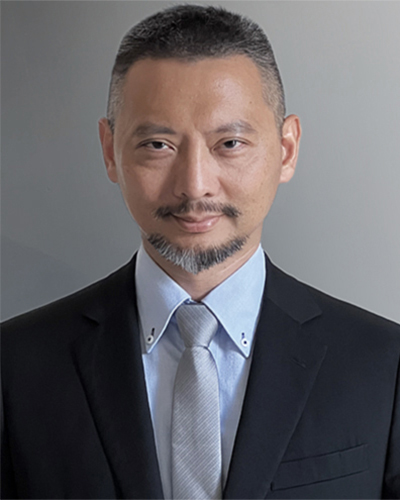
Tzu-Wei Hung (洪子偉)
Research Fellow
Tzu-Wei Hung
Research Fellow

Hung-Ju Chen (陳弘儒)
Assistant Research Fellow
Hung-Ju Chen
Assistant Research Fellow

Jay Jian (簡士傑)
Assistant Research Fellow
Jay Jian
Assistant Research Fellow

Bow-Yaw Wang (王柏堯)
Research Fellow, IIS
Bow-Yaw Wang
Research Fellow, IIS

Tyng-Ruey Chuang (莊庭瑞)
Associate Research Fellow, IIS
Tyng-Ruey Chuang
Associate Research Fellow, IIS